
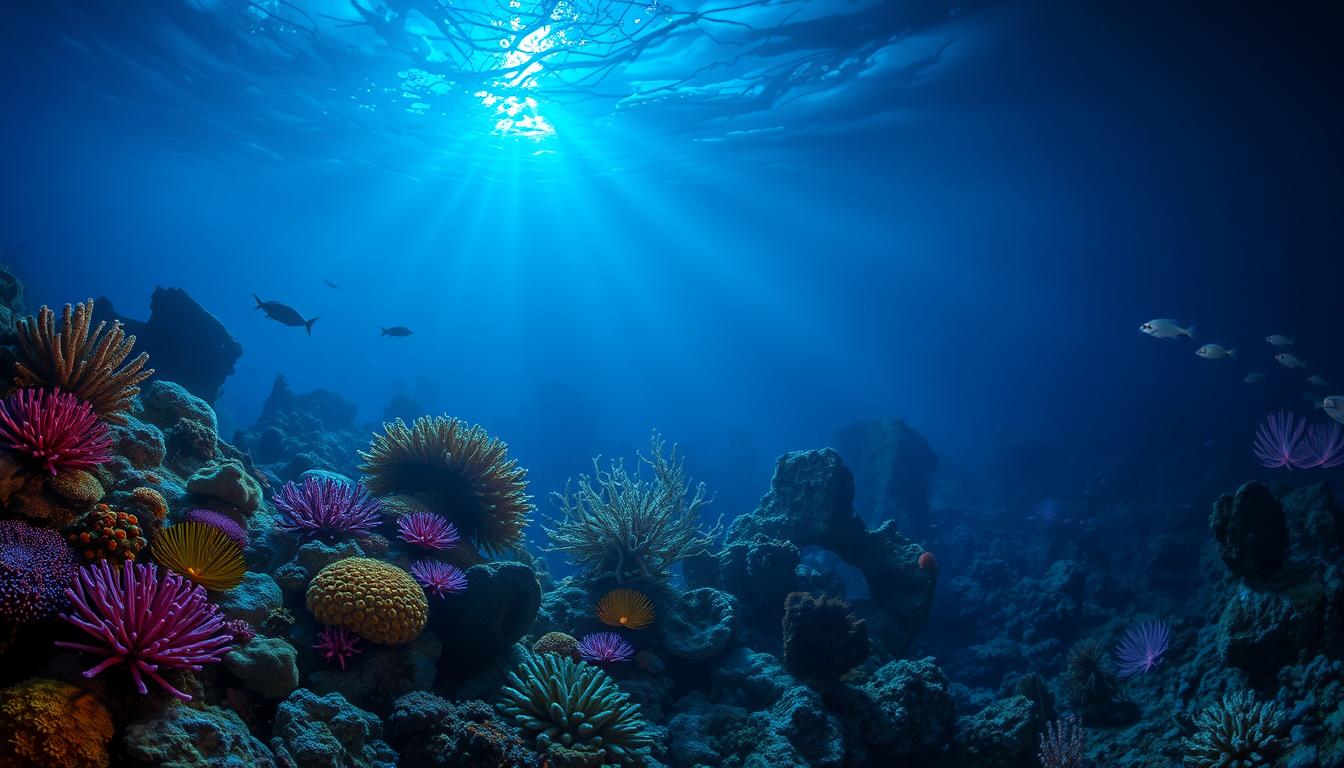
The ocean is huge, covering over 139 million square miles. But we’ve only explored about 20% of it. Underneath the surface, there’s a world full of secrets and wonders. This world of oceanography is key to understanding our planet’s biggest ecosystem and its big impact on marine life and climate.
From the bright surface to the dark depths, the ocean is full of mysteries waiting to be found. New ocean exploration tools are helping us see this hidden world. We’re finding amazing sea creatures, huge underwater mountains, and important ocean currents that shape our world. Each new find makes us more curious and shows how important it is to protect this vital resource.
Let’s start an exciting journey to explore the ocean’s secrets. Get ready to be amazed by the wonders under the waves. And learn how oceanography is crucial for our planet’s future.
Introduction to Oceanography
Oceanography is a fascinating field that explores the Earth’s oceans. It combines marine science, ocean research, and marine biology. Together, they uncover the secrets of the deep.
Pioneers like Jacques Cousteau and Sylvia Earle have shaped oceanography. They’ve mapped ocean currents and studied underwater ecosystems. Their work has greatly expanded our knowledge of the oceans.
“The sea, once it casts its spell, holds one in its net of wonder forever.” – Jacques Cousteau
Oceanography aims to understand the ocean’s role in the Earth’s systems. It looks at the physical, chemical, and biological processes in the oceans. This helps us tackle issues like climate change and protect marine life.
The work of oceanographers is crucial for our planet’s future. Their research helps us appreciate the oceans’ importance. It shows how vital they are for our planet’s balance.
The Structure of the Ocean
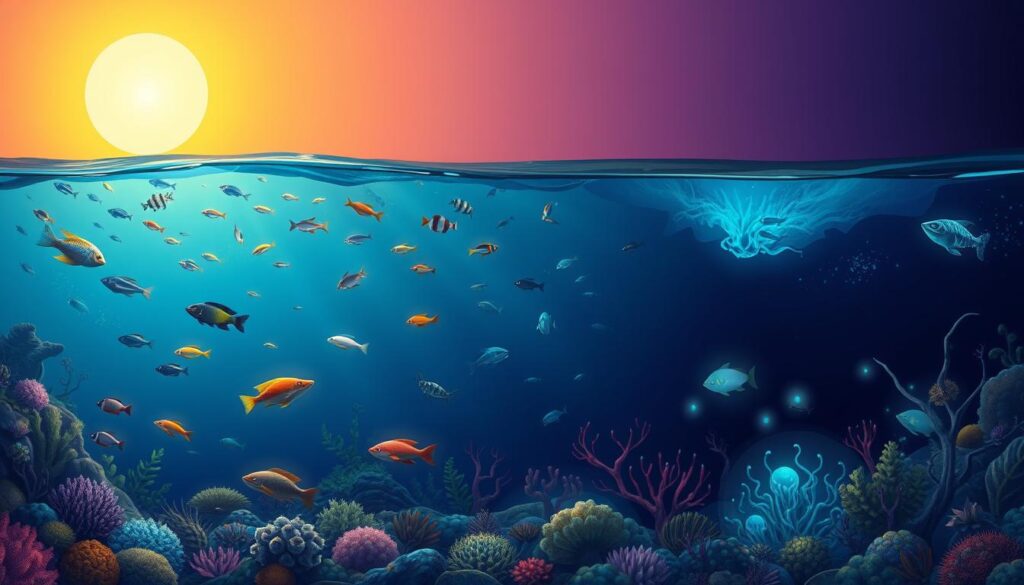
The ocean is vast and complex, divided into distinct layers. Each layer supports unique ecosystems. The epipelagic zone is at the surface, where sunlight allows photosynthesis.
Beneath it, the pelagic zone is a vast, mid-ocean area full of marine life. The benthic zone is the seafloor, home to organisms that live in darkness.
The hadal zone is the deepest part, with extreme pressure and little light. These layers are defined by changes in temperature, pressure, and light. These changes shape the diverse marine life in each zone.
“The ocean is like a great mystery, with so much yet to be discovered in its depths.” – Jacques Cousteau
Understanding the ocean’s structure is key to unlocking its secrets. By studying each layer, scientists can uncover the complex web of life beneath the waves.
Marine Life and Biodiversity
Dive into the captivating world of the ocean’s deep-sea creatures. Nature’s wonders never cease to amaze. From the luminous bioluminescence of the anglerfish to the colossal presence of the giant squid, the ocean’s depths harbor a wealth of unique and awe-inspiring marine life.
Explore the remarkable adaptations that allow these creatures to thrive in the extreme conditions of the deep-sea environment. Witness the stunning displays of bioluminescence. This natural phenomenon illuminates the darkness, enabling deep-sea organisms to communicate, attract prey, and even defend themselves.
Venture further into the ocean’s hidden realms and discover the vibrant hydrothermal vent ecosystems. Here, life flourishes in the midst of scalding hot, mineral-rich waters. These oases of biodiversity support a diverse array of deep-sea creatures, from the otherworldly tubeworms to the resilient extremophiles that call these unique habitats home.
“The ocean is the last frontier on Earth. With so much of it still unexplored, it’s a place of mystery and awe.” – Sylvia Earle, renowned oceanographer and explorer.
As we continue to unravel the mysteries of the ocean, we are constantly amazed by the resilience and adaptability of its inhabitants. Join us on this captivating journey of discovery. Here, the unknown becomes the known, and the wonders of the deep-sea world are revealed in all their glory.
The Technology Behind Ocean Exploration
The ocean’s depths have always fascinated explorers and scientists. To uncover its secrets, we use advanced technologies. Each tool plays a key role in exploring the ocean’s wonders.
Autonomous underwater vehicles (AUVs) and remotely operated vehicles (ROVs) have changed ocean exploration. These submersibles, with sensors and cameras, explore the ocean’s deepest parts. They map the seafloor and study marine life, making important discoveries.
Sonar technology helps map the ocean floor and find interesting areas. It sends sound waves and analyzes echoes. This way, scientists can create detailed maps, find shipwrecks, and spot marine life.
“The ocean is the last great unexplored frontier on our planet, and we have only begun to scratch the surface of its secrets.” – Robert Ballard, renowned oceanographer and deep-sea explorer.
Satellite oceanography uses satellite data to study the oceans. Satellites track ocean temperatures, currents, and marine life. This information helps guide further research and exploration.
As technology improves, we can explore the ocean more than ever. New submersibles and satellite systems will lead to more discoveries. We’ll gain a deeper understanding of our vast ocean ecosystem.
Ocean Currents and Their Impact
The world’s oceans are more than just water. They are complex systems with currents that shape our climate. The thermohaline circulation is a key part of this, moving water based on temperature and salt levels.
The Gulf Stream is a famous current. It starts in the Gulf of Mexico and moves up the east coast of the U.S. It helps keep temperatures steady and affects weather. El Niño, a periodic event, also impacts the world’s climate, leading to droughts and floods.
“Ocean currents are the circulatory system of the global climate, moving heat and nutrients around the planet.”
Knowing about ocean currents and their effect on the global climate is key. Scientists study the ocean, atmosphere, and land to predict climate change. This helps us prepare and find ways to adapt and mitigate its effects.
As we learn more about the ocean, the role of ocean currents in our climate will become clearer. Understanding these systems helps us prepare for the future. It ensures our oceans stay healthy and sustainable for years to come.
The Chemistry of Ocean Waters
The ocean is not just beautiful; it’s also a complex system. It’s ruled by chemical processes. The salinity, or salt concentration, changes a lot in different areas. This affects how marine life moves and lives.
The pH levels in the ocean are also key. When the ocean takes in too much carbon dioxide, the pH drops. This is called ocean acidification. It’s bad for marine life, especially for coral reefs and shellfish.
“The ocean is the lifeblood of our planet, and its chemistry is the foundation upon which all marine life depends.”
The dissolved gases in the ocean, like oxygen and carbon dioxide, are vital. They help marine life survive. The mix of these gases and ocean currents makes the ecosystem change and stay delicate.
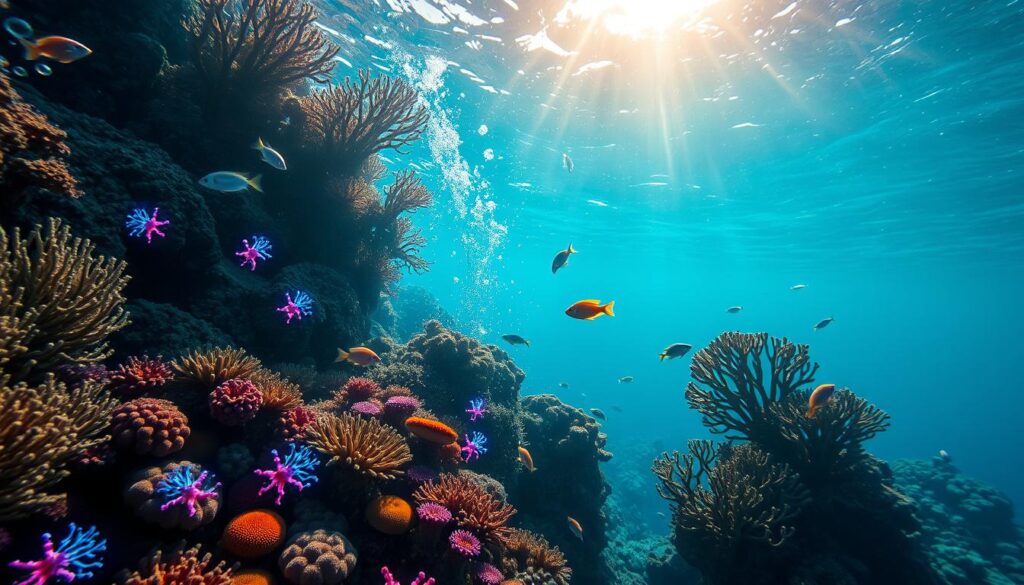
Exploring the ocean’s depths is crucial. We need to understand its chemistry to protect marine life. By studying salinity, pH levels, dissolved gases, and ocean acidification, we can help the ocean stay healthy. This is important for our planet’s future.
Seafloor Geology
The world’s oceans hide a fascinating landscape called the seafloor. It’s shaped by plate tectonics, mid-ocean ridges, deep-sea trenches, and seamounts. Each feature gives us a peek into how the Earth formed and evolved.
The seafloor moves constantly, thanks to shifting Earth’s crust plates. At mid-ocean ridges, new crust is made as plates pull apart. This pushes older crust into deep-sea trenches, where it sinks back into the Earth’s mantle. This process, plate tectonics, shapes ocean basins and creates the seafloor’s diverse features.
“The ocean floor is a vast and largely unexplored frontier, holding the secrets to our planet’s past and the key to understanding its future.”
Seamounts, or underwater mountains, are also part of seafloor geology. They can be over 5,000 meters tall, formed by volcanoes. These mountains support unique marine life. Scientists are still learning about these mountains and their role in the ocean.
Exploring the seafloor helps us understand plate tectonics, mid-ocean ridges, deep-sea trenches, and seamounts. This knowledge helps us protect and manage the ocean’s resources. It’s crucial for our scientific understanding and for the ocean’s future.
Oceanic Ecosystems
The ocean is full of different ecosystems, each with its own life and connections. From the colorful coral reefs to the green kelp forests and the lively mangroves, these places are key to the marine food webs. They help keep our oceans alive.
Coral reefs, known as the “rainforests of the sea,” face big challenges from climate change and human actions. These beautiful places are homes for many sea creatures, from tiny animals to big fish. Rising ocean temperatures and acid levels are causing coral bleaching, which is very harmful.
“Coral reefs are the canaries in the coal mine of our oceans, signaling the urgent need to address the global crisis of climate change.”
Kelp forests and mangroves are also very important. Kelp forests give food and shelter to many sea animals. Mangroves protect coastal areas from storms and high tides. But, they face dangers like being destroyed and polluted, which harms the marine food webs.
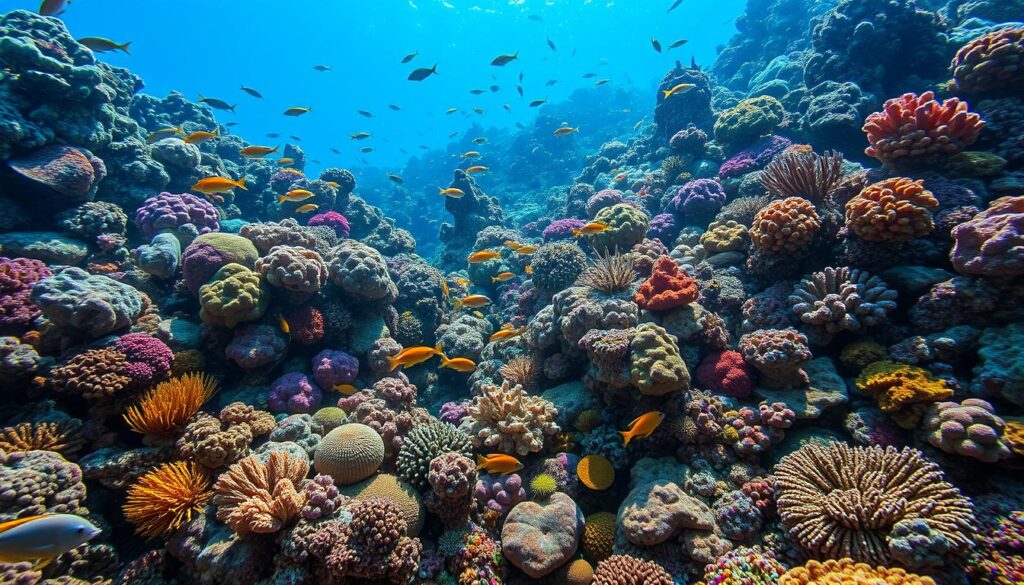
It’s crucial to save and fix these ocean ecosystems. They are not just important for nature, but also for people living near the coast. By learning about these ecosystems, we can help protect them. This will ensure a healthy future for our oceans.
The Influence of Human Activity
The ocean is vast and complex, but human actions affect it deeply. Overfishing, marine pollution, and plastic waste harm the ocean’s health. It’s vital to understand these impacts to protect the oceans.
Overfishing is a big threat to ocean ecosystems. Commercial fishing has reduced many fish populations. This disrupts the ocean’s food chain. Efforts to regulate fishing and protect marine areas are underway, but more is needed.
Marine pollution, especially from plastic, is another major issue. Millions of tons of plastic pollute the ocean each year. This harms marine life and ecosystems. Sea turtles and seabirds often mistake plastic for food, leading to injury or death. Cleaning up this pollution and preventing more waste is a global challenge.
Despite these challenges, there is hope. Governments, organizations, and individuals worldwide are fighting to protect the ocean. By reducing our impact on the ocean, we can ensure it thrives for future generations.
Climate Change and the Oceans
The planet’s rising temperature is hitting the oceans hard. Sea level rise is a big worry, threatening coastal areas and marine life. The ocean warming trend makes marine heatwaves more common and intense. These heatwaves can harm marine life and mess with ocean currents.
The oceans are fighting back, though. They act as a carbon sink, helping to keep global temperatures in check. But, as the oceans get more acidic, they can’t absorb carbon dioxide as well.
“The oceans are the silent victims of climate change, but their role in mitigating and adapting to its effects is critical.”
To tackle these ocean challenges, we need a broad strategy. We must cut down on greenhouse gases, protect marine habitats, and support new tech for ocean monitoring. By grasping the link between oceans and climate, we can aim for a greener future for our planet and its sea creatures.
The Future of Oceanography
Oceanography is on the verge of a new era. Emerging trends and tech advancements are opening up the ocean for exploration. The blue economy is growing, using the ocean’s resources for sustainable growth.
Marine biotechnology is changing how we see the ocean’s life. We’re finding new sea creatures and making new medicines and materials. This field is full of promise for science and real-world use.
Big data and artificial intelligence (AI) are changing ocean research. These tools help us understand ocean currents, marine life, and changes in the environment. They make sustainable ocean management more effective.
“The future of oceanography lies in our ability to collaborate globally, pooling our resources and expertise to tackle the complex challenges facing our oceans.”
Working together is crucial for these advancements. Researchers, policymakers, and industry leaders must join forces. Together, they can solve big problems like climate change, pollution, and resource use. This will ensure a bright future for the blue economy.
Conclusion: The Call for Exploration and Conservation
Exploring the ocean is key to unlocking its secrets. The sea’s vast, unexplored areas could lead to major discoveries. They can also help us understand marine life and the planet’s balance.
Teaching people about the ocean is vital. Educational efforts and awareness campaigns can deepen our understanding. This knowledge empowers us to protect marine life.
Creating more marine protected areas is crucial. These areas, thanks to global cooperation, protect vulnerable species. They help keep our oceans healthy, aligning with the United Nations’ Sustainable Development Goals.