
Time has always fascinated us, more than just a clock’s tick. We’ll explore time perception, measurement, and the science of time travel. From old timekeeping methods to how cultures view time, we’ll journey through time’s mysteries.
Time is key to our lives, sparking endless curiosity. How do we measure it, and how has our view changed over time? From ancient sky watches to mechanical clocks, our quest to grasp time shows human creativity and our drive to understand life.
We’ll look at natural timekeepers like stars and planets that guided us for ages. We’ll also see how mechanical clocks changed our time sense and how time zones were set up.
But time isn’t just about counting; it’s also a topic for deep thinking. We’ll learn about Albert Einstein’s work that changed our view of time. His ideas opened the door to the exciting idea of time travel.
Join us as we explore time’s wonders. We’ll share interesting facts, cultural views, and the latest in time science. Get ready to travel through time, where past, present, and future meet in a thrilling discovery.
The Concept of Time: A Brief Overview
Time has always fascinated philosophers, scientists, and thinkers. The definition of time sparks debate, with many theories on its nature. The philosophy of time looks at time and reality, while time theories try to grasp time’s underlying rules.
The debate centers on absolute versus relational time. Newton believed in absolute time, where time moves on its own. On the other hand, Leibniz thought time depends on how objects and events relate to each other.
“Time is not absolute, but rather relative to the observer and the frame of reference.” – Albert Einstein
Science has also shaped our view of time. Einstein’s theory of relativity changed how we see time and space. It showed a deeper connection between them and the universe.
The philosophy of time and time theories keep evolving. We’re still trying to figure out time’s true nature. This quest is both intriguing and ongoing.
Natural Timekeepers: The Role of Astronomy
Before mechanical clocks, ancient people used the sun, moon, and stars to tell time. This method, called celestial timekeeping, helped them plan their day, plant crops, and know when seasons changed.
The sundial was a key tool for tracking time. It worked by showing how the sun’s shadow moved on a surface. People in ancient Egypt, Greece, and China used sundials to keep their days in order.
Many cultures also used lunar calendars to follow the moon’s phases. The moon’s cycle, about 29.5 days, helped them plan their activities. The Babylonians, for example, used it to schedule farming and religious events.

Astronomy was crucial in improving timekeeping. By studying the sky, ancient astronomers made timekeeping more precise. This led to better calendars and time systems, vital for early societies.
Mechanical Clocks: The Revolution in Timekeeping
The history of clocks is filled with exciting moments. It started with ancient water clocks and moved to the pendulum clock by Christiaan Huygens. These devices changed how we see and use time.
The pendulum clock came in the 17th century. It used a swinging pendulum to make the clock more accurate. This was a big step forward from earlier clocks.
In the 20th century, the quartz clock was invented. It used quartz crystals to keep time very accurately. Quartz clocks are now in watches and digital displays, making timekeeping easy for us.
“The invention of the pendulum clock was a pivotal moment in the history of timekeeping, ushering in a new era of precision and reliability.”
Looking back, mechanical clocks have greatly influenced our view of time. From water clocks to quartz technology, clock history shows our constant pursuit of time mastery.
Time Zones: Why Do They Exist?
Our world is more connected than ever, making it crucial to standardize time. The idea of global time zones came up to make tracking time easier. Greenwich Mean Time (GMT) is the base for all other time zones.
The International Date Line is key to keeping days and dates in order worldwide. Without it, tracking time would be a mess. It runs roughly along the 180th meridian, keeping time consistent as we travel.
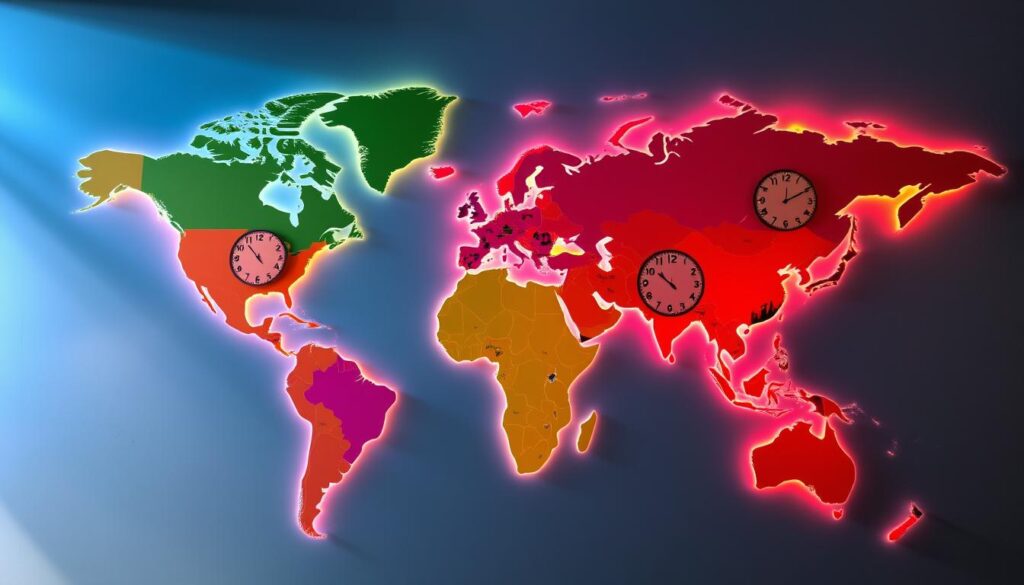
But, setting up time zones has faced many challenges. Some argue that time zones should match geography and culture better. Daylight saving time changes add more complexity to the system.
Despite these issues, time zones are essential today. They help with global communication, travel, and teamwork. As we advance in science and tech, understanding time zones will become even more important.
The Science of Time: Einstein and Beyond
Modern science has deeply explored the nature of time. Albert Einstein’s work on relativity led the way. He showed that time is closely tied to spacetime.
Einstein’s relativity theory changed how we see time. It showed that time can seem to slow down or speed up, depending on how fast you’re moving. This idea has helped us understand everything from GPS systems to the stars in the sky. As we learn more about quantum mechanics, time’s role in the tiny world becomes even more fascinating.
“Time is not absolute. It is relative to the observer’s frame of reference.” – Albert Einstein
Our understanding of time has grown, thanks to modern physics. As we keep exploring, time’s secrets keep us curious. It makes us think about our place in the universe and the mysteries it holds.
Cultural Perspectives on Time
Our view of time is shaped by our culture. Some groups see time as a line, with events linked by cause and effect. Others see it as a cycle, with time repeating itself. This difference in cultural time concepts affects how we live and work.
In cultures focused on linear time, setting goals and being on time are key. People value efficiency and meeting deadlines. On the other hand, cultures that see time as cyclical might focus more on the present. They celebrate the natural world and the connections between things.
“Time is not a commodity, something to be saved, spent, or wasted, but a medium in which we exist.”
– Alan Watts
The way we think about time also shapes how we talk, decide, and solve problems. In linear time cultures, planning and goal-setting are common. In cyclical time cultures, harmony and tradition are more important.
Knowing about these cultural time concepts helps us communicate better across cultures. By understanding and valuing both linear time and cyclical time, we can appreciate the diversity of human experience. This leads to better understanding and connection between people worldwide.
Fun Facts About Time Measurement Devices
In the world of time measurement, there are amazing devices and ideas that grab our attention. The atomic clock is one such wonder. It’s incredibly accurate, thanks to atoms that oscillate consistently. These clocks lose only a second every few million years.
Another interesting part of timekeeping is leap seconds. These adjustments keep our clocks in sync with Earth’s rotation. It prevents our time from drifting away from the sun. This ensures our universal timekeeping system stays accurate.
Time capsules give us a peek into the past. These containers, often buried or hidden, hold artifacts and messages from old times. They connect us to the past and future, making us think about time and our connection across ages.
“Time is the most valuable thing a man can spend.” – Theophrastus
From the atomic clocks’ precision to the fun of time capsules, time measurement is full of fascinating stories. These facts show us the creativity and curiosity behind our efforts to grasp the universe’s rhythm.
The Psychological Perception of Time
Studies have shown that our brains don’t always measure time right. The study of subjective time is very interesting in chronobiology. Our internal clocks can make a minute feel like an hour or vice versa, depending on many factors.
Our level of arousal greatly affects how we see time. When we’re excited or stressed, time seems to fly by. But when we’re bored or calm, time can feel like it’s dragging on. This happens because our brain’s way of handling time changes, influenced by chemicals like dopamine and norepinephrine.
“Time is an illusion. Lunchtime doubly so.” – Douglas Adams
The oddball effect is another fascinating phenomenon. It shows that an unexpected event can feel longer than usual. Scientists think this is because our brains focus more on these unusual events, making them seem longer.
By exploring how our minds perceive time, we learn a lot about ourselves. Time perception studies keep showing us how our brains, senses, and experiences are connected.
Time Travel in Popular Culture
Time travel has always fascinated science fiction fans and movie lovers. Classics like Back to the Future and modern shows like Timeless have made it a key part of our culture. These stories delve into the paradoxes and outcomes of changing the past or seeing the future.
The “grandfather paradox” is a famous example. It happens when a time traveler goes back and stops their own birth. This idea has been explored in many movies and books, making us think about time and reality.
“Time travel is one of the most fascinating concepts in science fiction. It opens up a world of possibilities and challenges our fundamental notions of time and causality.” – Renowned physicist, Stephen Hawking
Even though time travel is still science fiction, scientists are looking into it. They’re studying how to change time at a quantum level. This has inspired many stories, keeping audiences hooked.
From Bill and Ted‘s fun adventures to Inception‘s complex ideas, time travel in movies has grown. It shows how our views of the universe and our limits are changing. As science and tech advance, time travel will keep captivating us.
Historical Figures and Time Measurement
The history of time measurement is filled with the work of famous clockmakers and inventors. These pioneers have changed how we track time. From ancient astronomers to today’s engineers, they’ve made timekeeping devices more advanced.
Galileo Galilei, an Italian scientist, is a key figure in timekeeping history. His work on pendulum clocks helped make mechanical clocks more accurate. This changed how we measure time forever.
“The sun, with all those planets revolving around it and dependent on it, can still ripen a bunch of grapes as if it had nothing else in the universe to do.”
John Harrison, an English clockmaker, invented the marine chronometer. This device changed navigation and made sea travel safer. Harrison won the Longitude Prize in 1773 for his work.
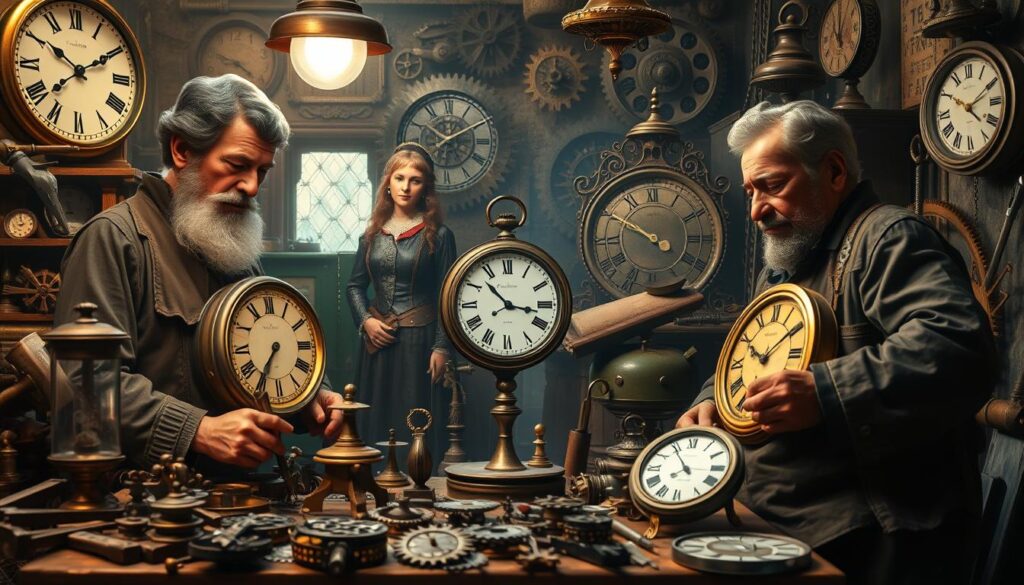
Today, Seiko and Citizen lead in horology. They’ve developed quartz and atomic clocks. These clocks are now the standard for timekeeping worldwide.
The work of these clockmakers and inventors has greatly influenced our view of time. It shows how far we’ve come in understanding and measuring time.
The Future of Time: What Could Change?
The future of timekeeping is full of exciting possibilities. Quantum physics could change how we measure time with ultra-precise quantum clocks. These clocks, based on atomic vibrations, could be more accurate than today’s best mechanical watches.
Space-based time measurement is also gaining attention. Satellites around Earth could be used as global time references. This could improve navigation, communication, and science, changing how we use time worldwide.
Our understanding of time is growing, thanks to modern physics. This could lead to a big change in how we see and use time. New theories and models might challenge our old ideas and bring new uses in tech and philosophy.