
Science is all about seeking knowledge and understanding. But, history shows us times when science went too far. These odd experiments tested what we thought was possible, making us question reality and science’s limits.
We’re going to explore “weird science,” revealing strange and thought-provoking experiments. From Tesla coils to the Stanford Prison Experiment, these studies shocked scientists and the public. They’ve left a lasting impact on our culture.
As we look into these odd scientific projects, we’ll learn about their goals, methods, and outcomes. This journey will show us how the quest for knowledge can lead to unexpected, sometimes unsettling, discoveries.
The Origin of Weird Science: A Brief Overview
The roots of “weird science” go back to ancient times. It started with curious philosophers and continued with modern researchers. The history of unusual experiments is key to scientific progress.
Scientists with scientific curiosity have always explored the unknown. They’ve pushed limits, making discoveries that changed our world. Their work has led to new fields and understanding.
“The most beautiful experience we can have is the mysterious. It is the fundamental emotion that stands at the cradle of true art and true science.”
– Albert Einstein
At first, some fringe research gets laughed at. But, history shows it can lead to big breakthroughs. It has brought us new tech and knowledge, pushing human understanding forward.
Science keeps growing, and we’ll see more amazing discoveries. The quest to explore and challenge the norm is what drives science. This scientific curiosity keeps “weird science” alive and exciting.
The Strange Case of the Tesla Coils
Nikola Tesla is known for his groundbreaking work in electromagnetic experiments and wireless electricity. His innovative mind led him to create the Tesla coil, a unique and fascinating device. It’s a key part of science history.
Tesla coils are electrical transformers that can produce amazing electrical discharges. They create stunning displays of plasma, like lightning. Tesla worked hard to make electricity wireless, a dream he had for years.
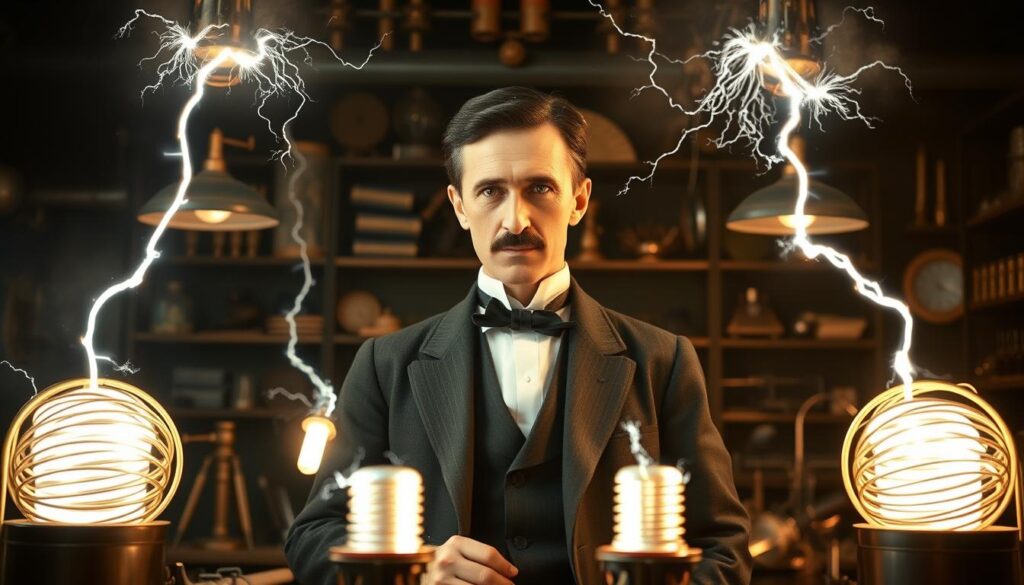
As Tesla’s work grew, so did his coils. They could create electrical arcs that jumped several feet. The sight of these coils was mesmerizing, with their crackling electricity and glow. They inspired science fiction and stage shows.
But Tesla’s coils did more than entertain. They helped create modern technology like radio communications and the electric power grid. Tesla’s dream, despite doubts, still motivates scientists and inventors today.
“If you want to find the secrets of the universe, think in terms of energy, frequency, and vibration.”
– Nikola Tesla
The Stanford Prison Experiment: Ethics in Question
The Stanford Prison Experiment, led by Philip Zimbardo, is a landmark study in psychology. It explored how power and situations affect people. This study has raised many questions about the ethics of psychological research.
In 1971, Zimbardo’s team turned part of Stanford University into a mock prison. They chose college students to be guards and prisoners. The study quickly turned chaotic, with guards becoming very authoritarian and prisoners showing signs of distress.
“The experiment spun out of control. I lost my sense of what I was doing, how I was behaving, how I was letting things happen without intervening.”
The Stanford Prison Experiment showed the dangers of psychological studies. It raised big ethical concerns. These concerns have led to new rules and checks for research involving people.
Today, people still talk about the Stanford Prison Experiment. Some doubt its findings, while others see it as a key to understanding human nature and the dangers of power.
This study reminds us of the importance of ethics in research. It shows the need to always put the well-being of participants first in psychological experiments.
The Antarctic Ice Core Project
The Antarctic Ice Core Project is a key part of climate research. It shows our deep desire to know our planet’s past. Scientists have found a wealth of information in the Antarctic ice, changing paleoclimatology forever.
They take ice cores from the Antarctic ice sheets. These cores are like a timeline, showing the atmosphere, temperature, and more from long ago.

Working in Antarctica is tough. Scientists face extreme cold, rough terrain, and big challenges. Yet, they work hard to understand Earth’s climate history.
By studying ice cores, scientists learn about our planet’s past atmospheres. This knowledge helps us deal with today’s and tomorrow’s climate issues.
“The Antarctic Ice Core Project is a testament to the power of scientific exploration and the human spirit. By delving into the icy depths, we uncover the stories of our planet’s past, empowering us to make informed decisions about its future.”
The climate crisis is a big challenge for the world. The Antarctic Ice Core Project gives us important insights. Scientists keep working together to find more secrets in the Antarctic ice.
The Boston Molasses Disaster: A Sticky Situation
In 1919, a strange accident happened in Boston. A huge tank burst, spilling over 2 million gallons of molasses. This molasses wave destroyed parts of Boston’s North End, causing damage and loss of life.
Scientists studied this event to learn about fluid dynamics. They wanted to understand how the molasses moved so fast and caused so much harm. This disaster also led to better urban planning and safety measures.
The Boston Molasses Disaster is still talked about today. It shows how unexpected industrial accidents can happen. It also reminds us of the importance of safety and understanding how things move.
“The molasses was dark brown, thick, and sticky, and it had a sweet, heavy smell. It moved with tremendous speed, at least 35 miles an hour.”
Today, the Boston Molasses Disaster is a lesson in fluid dynamics and the dangers of industrial accidents. It’s also a part of urban legends that fascinate people in Boston and beyond.
Feline Telepathy: The Experiment that Shocked Cat Owners
Scientists have always been curious about telepathy in cats. This study has caught the attention of both pet owners and researchers. It has led to some surprising experiments.
In the 1960s, Dr. Rupert Sheldrake did a famous study on cat telepathy. He separated cats from their owners in different rooms. Then, he watched how cats reacted when their owners called out.
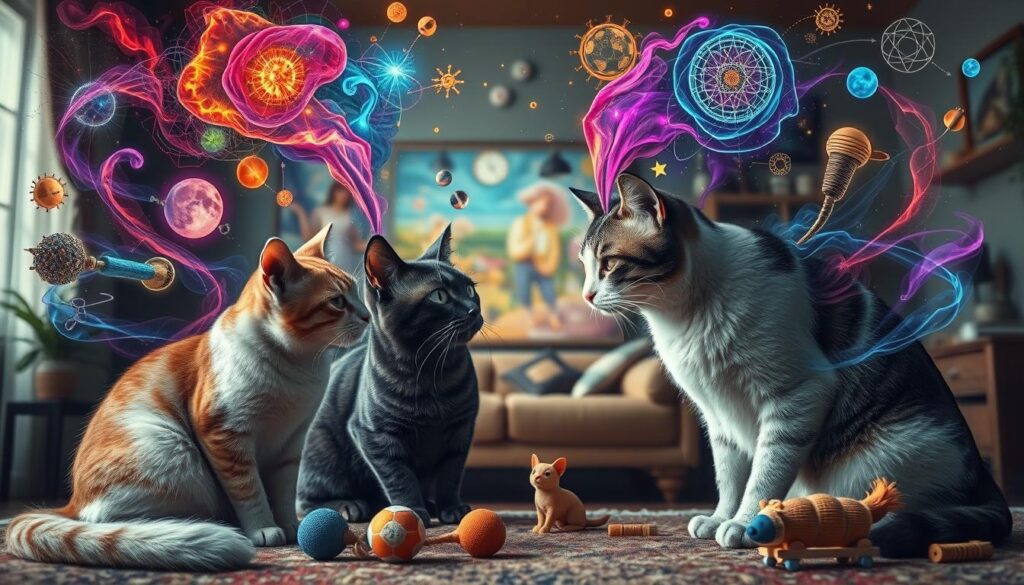
The results were shocking. It seemed cats could sense when their owners were calling. They would often stand up or move towards the door before they were called.
“The cats seemed to be aware of their owners’ intentions, even when separated by distance. This was a remarkable finding that challenged our traditional understanding of animal behavior and cognition.”
The findings have started a big debate in science. Some say it’s just chance or bad science. But others think it shows a new side of animal behavior and animal cognition.
The study of parapsychology is still growing. Looking into pet behavior and telepathy in animals is very interesting. It keeps scientists and cat lovers curious.
The Science of Laughing Gas
Nitrous oxide, also known as “laughing gas,” has a rich history. It was first made in the late 18th century. But, it wasn’t until the early 19th century that its true power was discovered.
The history of nitrous oxide in anesthesia is fascinating. In the 1840s, dentists started using it to ease pain during dental work. This was a big step forward in pain management in medicine.
Today, nitrous oxide is used in many medical areas. It helps with pain during surgeries and childbirth. This has changed how doctors and nurses handle pain.
“Nitrous oxide was a game-changer in the world of anesthesia, allowing for more humane and effective medical treatments.”
But nitrous oxide’s story doesn’t stop there. It’s also used for fun, with its ability to make people feel happy and see things differently. This has led to concerns about its misuse.
Exploring nitrous oxide’s science is complex. We must balance its medical benefits with the risks of recreational use. This ensures it’s used safely and responsibly.
The Effects of Isolation: The Monkey and the Doll
Harry Harlow’s work has sparked a lot of debate and thought. He was a famous American psychologist who studied attachment theory in the 1950s and 1960s. His goal was to understand why we need emotional connections and how isolation hurts us.
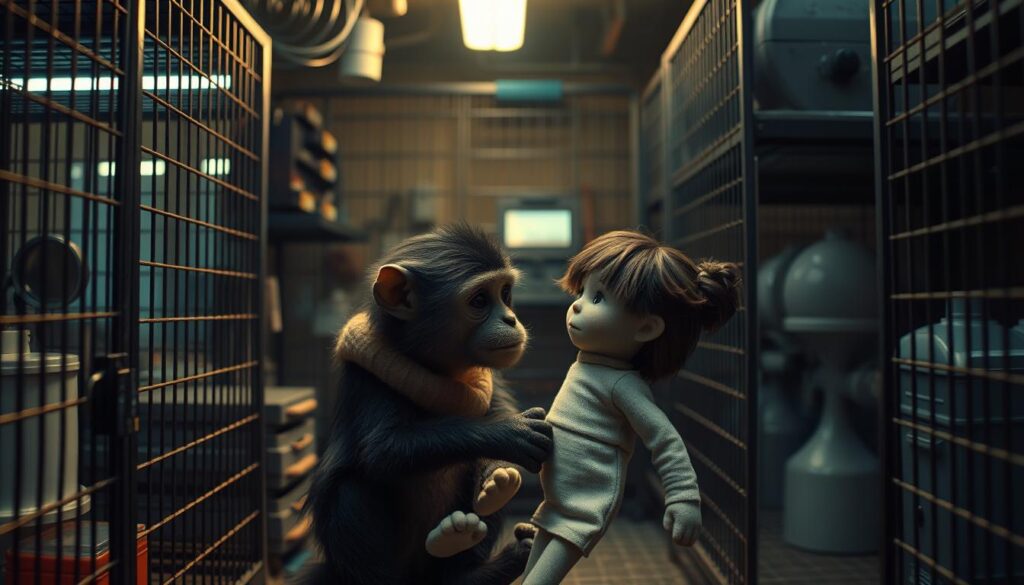
Harlow used rhesus monkeys in his research. He thought they could help us understand human attachment. He separated young monkeys from their mothers and gave them fake “surrogate” mothers. This was to see how maternal deprivation affects them.
The results were both interesting and sad. Harlow found that monkeys without a caring mother showed many problems. They rocked themselves too much, hurt themselves, and had trouble making friends later. These findings changed how we see the importance of early life experiences in shaping us.
“The nature of the child’s tie to his mother is by no means fully understood.”
– Harry Harlow
Harlow’s work also made us think more about animal welfare and the ethics of science. But his biggest impact is on how we value love, connection, and belonging. His research on isolation has influenced psychology, child development, and social policies for years.
The Role of LSD in Psychology Research
In the mid-20th century, psychology saw a deep dive into consciousness with LSD. Timothy Leary led the way in psychedelic studies. He aimed to understand the human mind better.
Leary’s work at Harvard in the 1960s sparked interest in LSD’s therapy. He gave the drug to volunteers to study consciousness. His results changed how we see mental health and reality.
“The psychedelic experience is a journey to new realms of consciousness.” – Timothy Leary
But, psychedelic studies faced controversy. LSD’s use for fun raised safety and abuse concerns. This led to its ban and ended many studies. Yet, Leary’s work still shapes today’s psychology.
Now, science is looking at psychedelic studies again. The past teaches us to explore consciousness and therapy safely. The future of mind research is exciting, with many challenges ahead.
The Impact of Weird Science on Popular Culture
Weird science has made a big impact on popular culture. It has inspired many science fiction, horror, and fantasy works. From classic mad scientists to modern films, people love the strange and unexplained.
Science fiction is a key area where weird science thrives. Classics like “Frankenstein” and “The Island of Dr. Moreau” show the dark side of science. These stories have shaped our views of mad scientists and the dangers of their experiments.
The movies have also explored weird science. Films like “The Fly,” “Jurassic Park,” and “The Manchurian Candidate” have captivated us. They show the risks of scientific experiments and make us think about ethics and technology.