
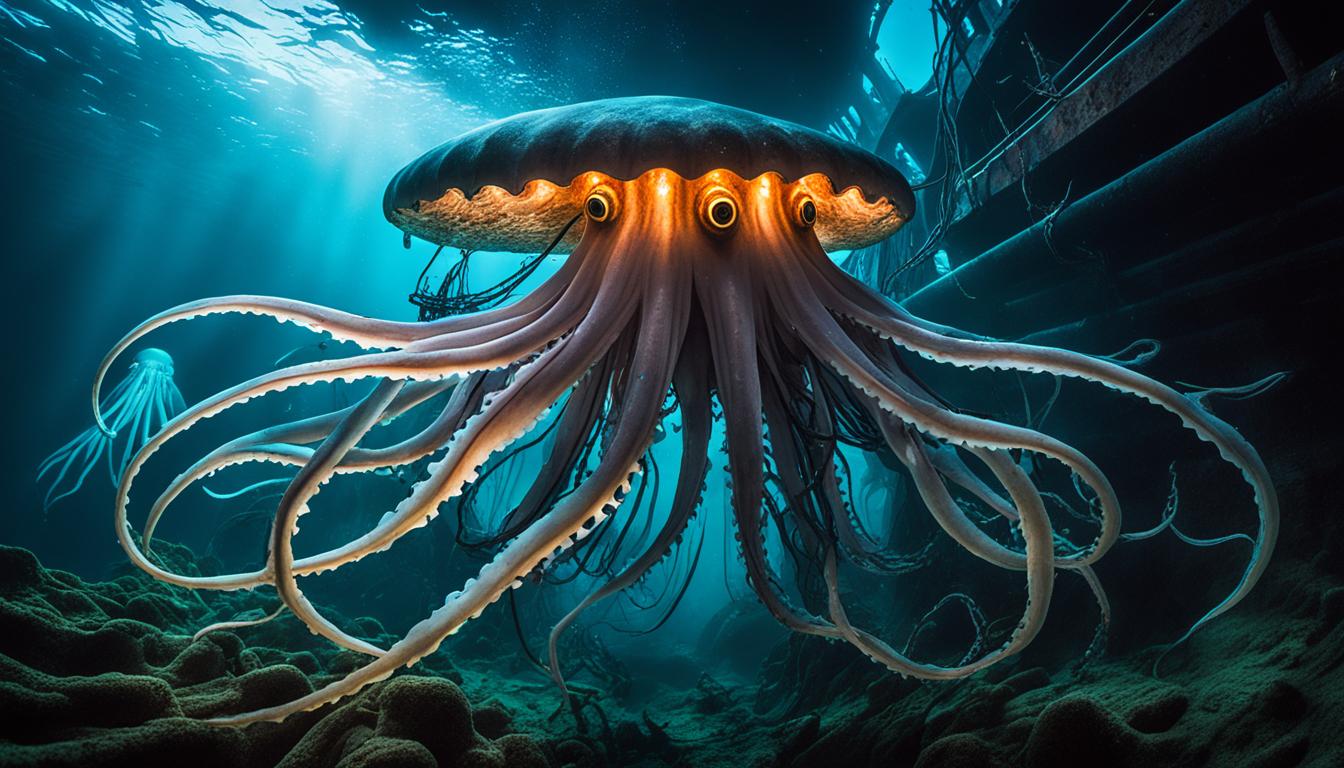
Get ready to explore the deep sea, where the known and unknown meet. This article will reveal amazing facts about the ocean’s deep, from the Hadal Zone‘s extreme pressure to the stunning bioluminescent lights of its creatures. Discover the secrets of the abyssal realm, a place still largely unknown to us.
The Abyssal Realm: Unraveling the Mysteries
Step into the mysterious abyssal realm, where the ocean floor drops to incredible depths. This area, from about 13,100 feet to nearly 20,000 feet, is filled with extreme pressure. The weight of the water above can crush even the strongest creatures.
The Hadal Zone: Life at Crushing Depths
Go deeper into the abyssal realm to reach the Hadal Zone, the ocean’s deepest part. Here, in total darkness, the pressure is a massive 15,000 pounds per square inch. This force could crush anything. Yet, some deep-sea creatures have adapted to live here.
Bioluminescent Wonders: Nature’s Neon Lights
Bioluminescence is a fascinating sight in the abyssal realm. Deep-sea creatures use light to communicate, catch prey, and defend themselves. These glowing creatures, like glowing squid and luminescent shrimp, light up the dark depths with nature’s neon lights.
Fun Facts: Prepare to be Amazed
Dive into the world of deep sea fun facts and discover the amazing wonders beneath the ocean. You’ll see creatures that look like they’re from another world and learn how they survive in the deep sea. This section will amaze you with the ocean’s secrets.
The anglerfish uses a glowing lure to talk to its prey. This is just one of the many strange facts about the ocean. The goblin shark also has a jaw that can stretch out to catch its prey.
Get ready to meet the giants of the deep sea. The giant squid can grow up to 43 feet long, making it one of the biggest invertebrates on Earth. These creatures are truly beyond imagination.
The deep sea is full of glowing lights and creatures that can live in extreme conditions. Dive into these deep sea fun facts and learn about the mysteries of this amazing place.
Bizarre Creatures of the Deep
Step into a world where deep sea creatures push the limits of what we can imagine. These unusual ocean animals come from the ocean’s depths, each with amazing adaptations for survival. The Goblin Shark is one of these creatures, a nightmarish predator from the abyssal zone.
The Goblin Shark: Nightmarish Predator
The Goblin Shark has a jaw that looks almost alien. It can strike fast to catch its prey. Its special senses help it find prey in the dark deep sea, making it a top predator.
These deep sea creatures are adapted to live in the deep ocean’s tough conditions. They fascinate scientists and fans with their strange looks and survival skills. They show us the wonders of the ocean’s unknown parts, full of mysteries waiting to be found.
Colossal Giants: Dwarfing Mythical Beasts
Get ready to be amazed by the huge creatures of the deep sea. These massive animals are bigger than any mythical beasts. They are key to keeping the deep-sea world balanced.
The deep sea is home to giants like the colossal squid, giant oarfish, and whale shark. These creatures are not just huge; they have special features for living deep in the ocean. Their size and strength show us the magic of the deep sea.
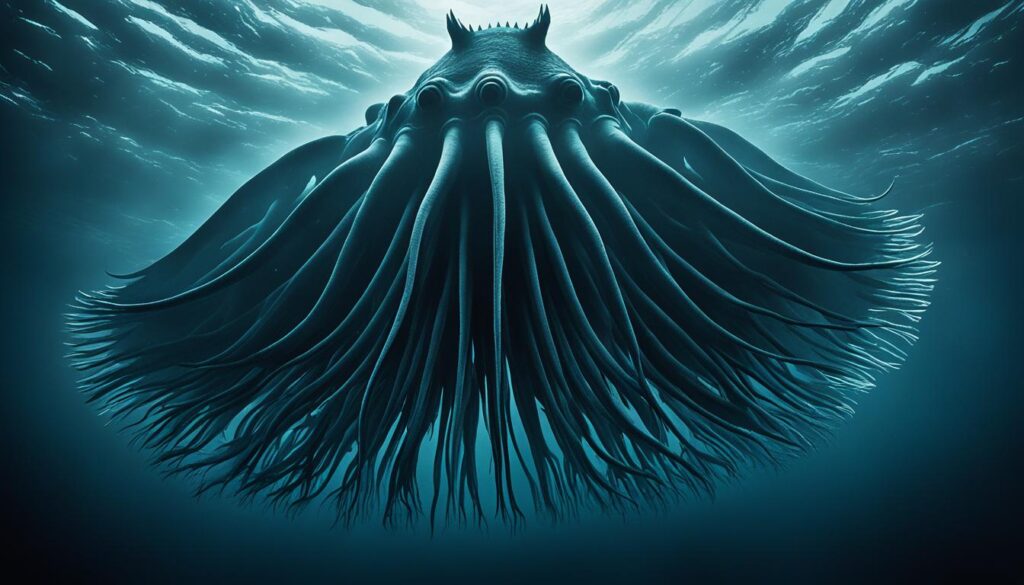
These giants are important for the ocean’s health. They control the food chain as top predators or by filtering the water. Knowing how they interact with their world helps us protect our oceans.
Exploring the deep sea might lead to finding even bigger sea animals. The deep sea is still a mystery, full of wonders waiting to be discovered. It challenges us to learn more and shows us the beauty of the ocean.
Hydrothermal Vents: Oases of Life
Deep in the dark sea, a special event happens. Hydrothermal vents on the ocean floor burst with hot, mineral-rich water. This creates places of life in a tough environment. These deep sea spots are full of extremophiles – life forms that live in extreme conditions.
Extremophiles: Thriving in the Harshest Conditions
Extremophiles use chemosynthesis to survive the deep sea’s high pressure, extreme heat, and lack of sunlight. They include tube worms, clams, and microbes. These organisms make their own food from the chemical energy of the vents, just like plants make food from sunlight.
This lets them live in dark, rich waters that would kill most other life. It’s amazing how they can survive in such a tough place.
The variety of life near hydrothermal vents shows how resilient and adaptable deep sea life is. From tall tube worms to pale crustaceans, these extremophiles have learned to survive in a very hard environment. They prove that life can exist in even the most challenging parts of our planet.
The Mariana Trench: A Staggering Chasm
Explore the Mariana Trench, the deepest part of the ocean. This incredible place has depths that are hard to imagine. It’s where the ocean floor drops to incredible depths, creating a world of huge pressure.
When you go down into the Mariana Trench, you enter a world like no other. The deepest point, the Challenger Deep, goes down 10,994 meters (36,070 feet). This shows how powerful and vast our oceans are.
The pressure at these depths is incredibly high. At the Mariana Trench’s bottom, it’s over 15,000 pounds per square inch. This is so strong it would crush a human easily. But, life still exists here, with creatures that have adapted to this extreme place.
Deep-Sea Currents: Invisible Forces
Under the ocean’s surface, deep-sea currents work as powerful, unseen forces. They shape our planet in ways we can’t see. These currents are part of a global system called thermohaline circulation. It’s key to the ocean’s rhythm.
Thermohaline Circulation: Driving the Ocean’s Heartbeat
Thermohaline circulation moves the ocean’s currents because of temperature and salinity differences. Warm, salty water cools and gets denser, sinking to the bottom. This creates a flow that moves heat, nutrients, and oxygen around the world’s oceans.
This system, known as the “ocean’s global system,” is vital for the climate and life in deep-sea areas. It helps distribute heat, nutrients, and oxygen from the Arctic to the Antarctic.
By studying thermohaline circulation and deep-sea currents, we learn about our planet’s ocean system. We see how it affects our world and the life in it.
The Midnight Zone: A Realm of Eternal Darkness
Step into the midnight zone, the deepest part of the ocean. Here, sunlight doesn’t reach, and creatures light up the darkness with their glow. Learn about the amazing ways these deep sea animals live in the dark, where secrets of the ocean await.
In the midnight zone, the pressure is high and there’s no light. Yet, many different kinds of life exist here. They glow in the dark and have special ways to survive. This place shows how life can adapt and thrive in tough conditions.
Going deeper into the dark ocean reveals a new world. Here, being able to make or see light is key to survival. The creatures here have evolved special skills to move through the darkness. Discover the secrets of the midnight zone and see how these deep sea animals live in the dark.