

In today’s fast-changing world, thinking critically and analyzing information scientifically is key. By making students curious and using the scientific method, we help them think more deeply. This article will show how to make science education improve analytical reasoning and STEM learning.
Thinking critically means questioning and exploring the unknown. By making students curious and helping them find answers, we encourage them to learn more. The scientific method is great for this, focusing on testing ideas and observing the world.
Fostering a Curious Mindset with Science
In science education, having a curious mindset is key for critical thinking. By encouraging students to dive into the unknown, we help them grow. This section talks about how to keep students curious and eager to learn about the world.
Nurturing Inquisitiveness
Science can spark curiosity in young people. By asking deep questions and letting students explore nature’s secrets, teachers can help them stay curious. This makes science more interesting and builds a lifelong love for learning.
Embracing the Unknown
The unknown is exciting for curious minds. Science should teach students to be okay with not knowing everything. By welcoming new discoveries, we create a space where students feel free to ask, experiment, and learn more. This openness is crucial for critical thinking and moving science forward.
Applying the Scientific Method to Daily Life
Using the scientific method can change how we solve problems and think critically every day. It helps us by breaking down challenges into smaller parts. We can then use observation, making hypotheses, testing, and analyzing to find answers.
In our daily lives, this method helps us make better choices. It’s useful when picking the best product or solving household problems. At work, it leads to more creative and data-based solutions, improving results. The main idea is to be curious, open to new ideas, and base our conclusions on what we see and test.

By making the scientific method a habit, we boost our critical thinking and problem-solving skills. This way, we make smarter choices in both our personal and work lives. It makes us think deeply about problems and find solutions based on facts and logic.
Asking Thought-Provoking Questions
Science education is more than just learning facts and theories. It’s about growing a curious mind that questions everything. Asking deep questions helps students think deeply and see things from different views.
Challenging Assumptions
We often accept things without questioning them. Critical thinkers question these beliefs and look at problems differently. By making students question what they know, we help them think on their own and make their own decisions.
Promoting Open-Ended Inquiry
Open-ended inquiry is about exploring and finding new insights, not just the right answer. This way of learning makes students curious and helps them solve problems. By asking questions with no clear answers, we encourage them to dive deeper into their learning.
Hands-On Experimentation and Discovery
Learning science is more than just reading books. It’s about doing things yourself and finding things out. By trying things out and exploring, students become more curious and think deeply. This way, they understand science better and get better at solving problems.
Interactive Learning Experiences
Hands-on learning is important for critical thinking. Students get to change things, see patterns, and make their own discoveries. This makes learning science more meaningful and lasting.
Encouraging Exploration
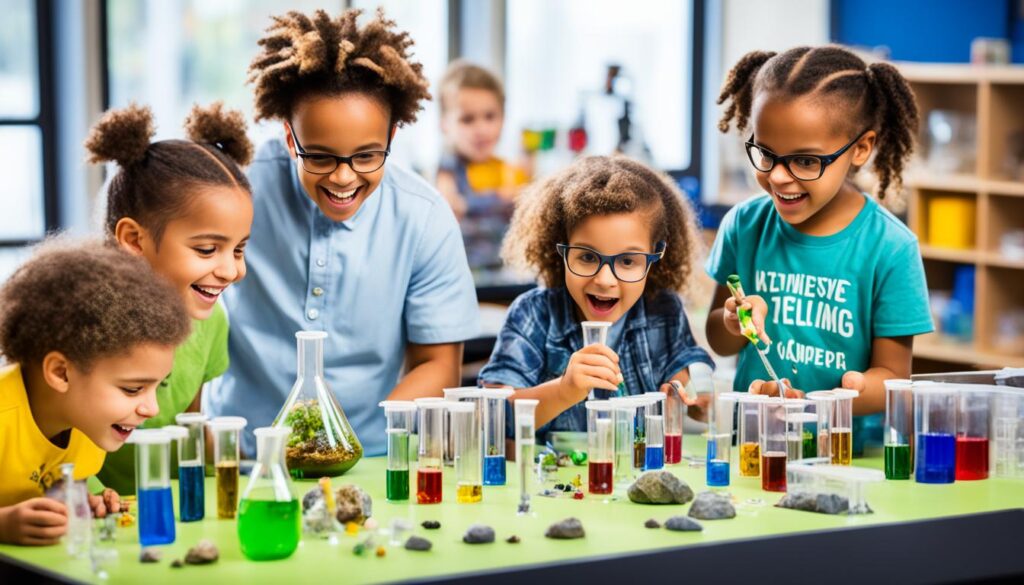
Letting students explore science on their own helps them think better. By doing experiments, they learn to question, doubt, and find answers. This way, they get important skills like observing, analyzing, and solving problems. These skills are key for doing well in school and life.
Developing Observation and Analysis Skills
It’s key to develop strong observation and analysis skills for critical thinking in science. By improving our observation, collecting and interpreting data, and making logical conclusions, we help students think deeply and analytically.
Getting students to really look at the world helps them reason scientifically. They might study a plant’s details or watch an animal’s behavior. This close observation sharpens their skills. It prepares them for more complex analysis and critical thinking later on.
But it’s not just about observing. Analyzing data and making smart conclusions is vital for critical thinking in science. By having students collect, organize, and understand data, we boost their analysis skills. This hands-on approach makes them think deeply, question things, and follow the scientific method.
Strong observation and analysis skills are key to critical thinking in science class. By making students active learners, we encourage them to explore, question, and find out about the natural world.
Science in the Classroom: Fostering Critical Thinking
Teaching critical thinking in science class is crucial. By using engaging lesson plans and promoting teamwork, teachers help students think deeply. This way, students learn more than just facts. They also get ready to solve complex problems and make smart choices.
Engaging Lesson Plans
Creating lesson plans that spark curiosity is important. Include activities that make students think and explore by doing. Ask them to use the scientific method, predict outcomes, and analyze data.
Encourage them to question and challenge assumptions. This helps them think critically and apply what they learn to real life.
Collaborative Learning
Working together in class helps students think better. Through group discussions, they learn to see different viewpoints, support their ideas, and solve problems as a team. This improves their science knowledge and teaches them important skills like communication and teamwork.
By using engaging lessons and teamwork, teachers make science exciting and meaningful. This approach helps students think critically, solve problems, and appreciate science more. It prepares them for the challenges of today and tomorrow.
The Role of Technology in Critical Thinking
Technology has become a key tool in science education. It helps students develop critical thinking skills. Through digital tools, teachers can make learning fun and challenging.
Technology lets students experience real-world scenarios in the classroom. For example, interactive simulations let them change variables and see the effects. This helps them think critically and understand science better.
Tools for data visualization and online research help students work with big datasets. They learn to analyze data, spot patterns, and make informed conclusions. These skills are vital for critical thinking in science.
Technology also promotes teamwork in science classes. Students can share ideas and solve problems together online. This teamwork helps them see different viewpoints and question their own beliefs. It boosts their critical thinking skills.
To sum up, technology is a great way to improve critical thinking in science classes. By using digital tools, teachers can make learning exciting. Students get to explore science, analyze data, and think deeply about the world.
Encouraging Skepticism and Evidence-Based Reasoning
It’s key to teach students to be skeptical and focus on evidence. This helps them become better thinkers and citizens. They’ll learn to handle the world’s complexities.
Teaching students to question what they hear is important. They should look closely at the data and sources. This helps them spot biases and make smart choices based on facts.
Creating a space that values curiosity and analysis is also crucial. It lets students question what they know and explore new ideas. By doing science, they learn to design experiments and analyze data. This way, they get a deeper understanding of science and develop critical thinking skills.